Pests
The most common type of pest you will probably encounter with your insect collection at some point is the dermestid beetle, or more specifically,
their larvae. There are many, many species of dermestids, the screen shot below shows just some. Don't get me wrong, they are important decomposers in
our ecosystem--without them and other scavangers, the world would be littered with dead things that never fully decompose. Some even eat hair. Forensic
crime labs use them. Some people farm them for cleaning bones. However, they do not have a place among insect collections because they well, want to do
their jobs.
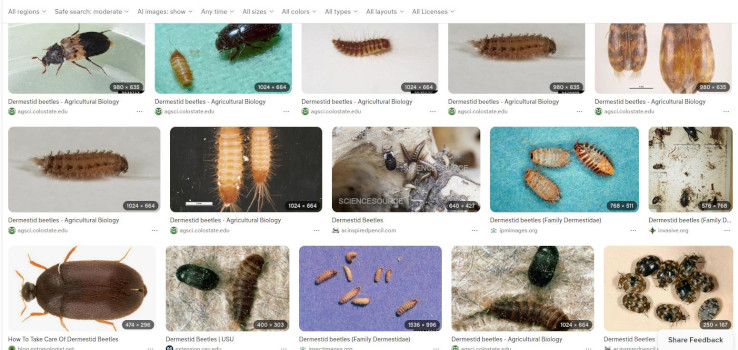 You can see several different species of dermestid beetles and larvae in this search screen shot.
If you look closely, middle row, right, it looks like someone's insect collection was ravaged.
They are particularly insidious in my opinion because you will most likely never see the adults. They like to hide in crevices or under things during the day,
come out at night and lay their eggs (which are tiny) near a food source. When the eggs hatch, the larvae feed from the insect specimen, consuming all
parts, and leaving behind what looks like dust, which is their frass (poop). As the larvae grow, they will molt, leaving behind small segmented translucent tan
exoskeltons. Living larvae can resemble small caterpillars due to their long setae. You may or may not see the shed exoskeletons in your mounts, you may only see
frass as evidence.
In my own collection:
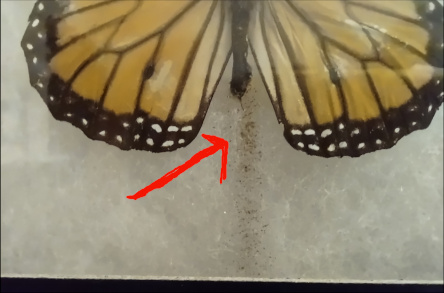
Left: Minor damage, small amount of frass. This specimen was saved.
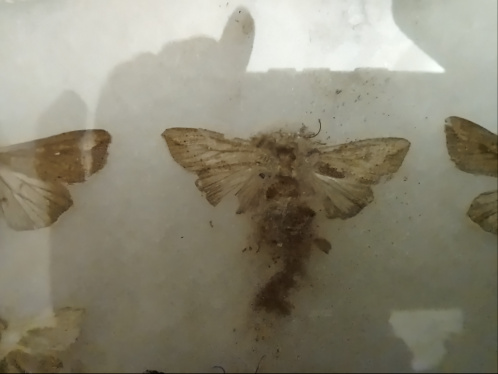
Right: Devastating damage. This specimen is no longer even identifiable.
Weirdly, the dermestids singled out this individual for the most part.
One of the benefits of riker mounts is that the polyfill is white, which shows the frass easily, allowing you to act. A disadvantage is that it's impossible to clean
all of it out of the mount afterward. Even better is prevention.
What to do?
Whether it's for an active infestation or prevention, the method I use is the same: Mini moth balls. In the US, these contain napthalene and/or p-Dichlorobenzene
so it's important that you protect your hands and airway by using gloves and either doing this outside or wearing a respirator or N95 mask. Be quick to
limit your exposure.
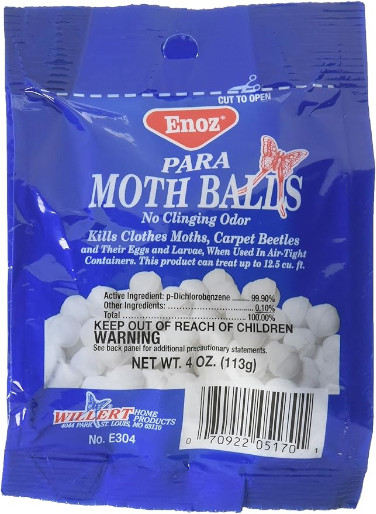
What I use.
This company has always bothered me for using an image of
a comet moth, a member of the Saturniidae family with vestigial
mouth parts meaning it doesn't eat anything (It's larvae eat leaves).
I've met people who think all moths are bad and eat clothes and I worry
this imagery reinforces this idea. It works well, though.
You can get it on amazon here for less than $6.
Open the riker mount and place one mini moth ball in each corner and close the mount. Put the whole mount (if small enough) into an appropriately sized plastic zip
bag and seal it. For larger mounts, I have put gallon sized bags over each end, slightly overlapping the edges and it has still worked well. I then put this out in my
garage in a dark area and wait a month or so. If you don't have a garage, an area of your basement or a room in your house far from your bedroom that you don't spend a
lot of time in will work. After about a month, I check to see if I can still smell the moth balls through the outside of the zip bag(s). If I can't, I'll then remove the
mount and give that a sniff. If I can still smell it then, I leave it longer. If I can't, it comes back in the house.
The kind of cool thing about the mini moth balls is that they will melt into the polyfill of the riker mounts; the polyfill will be impregnated with the chemical and
should protect the specimens for at least a year.
Next: Preservation